
NEMA17 vs NEMA23: Stepper Motor Selection Scheme for RepRap/Prusa/Voron Open Source 3D Printers
Selecting a stepper motor for an open-source 3D printer is not a matter of choosing the largest frame that fits the machine. In RepRap, Prusa, and Voron-class printers, the motor must match the motion architecture, the moving mass, the driver current limit, the supply voltage, the belt or screw ratio, and the intended print envelope. A larger motor can increase static torque, but it also raises rotor inertia, mass, current demand, and thermal load. In many cases, that trade is unfavorable for a fast desktop printer.
The term “NEMA” defines the motor face size, not its torque by itself. In the data set referenced here, the NEMA 17 motors are built on a 42 × 42 mm frame, while the NEMA 23 motors use a 57 × 57 mm frame. Within each family, torque varies significantly with stack length and rated current. On the referenced NEMA 17 page, examples range from a short 20 mm motor rated at 13 Ncm and 1.0 A per phase up to a 48 mm motor rated at 65 Ncm and 2.1 A. On the NEMA 23 page, examples span roughly 1.16 Nm at 1.5 A through 1.9 Nm at 2.8 A and up to 3.0 Nm at 3.5 A per phase, with much longer motor bodies.
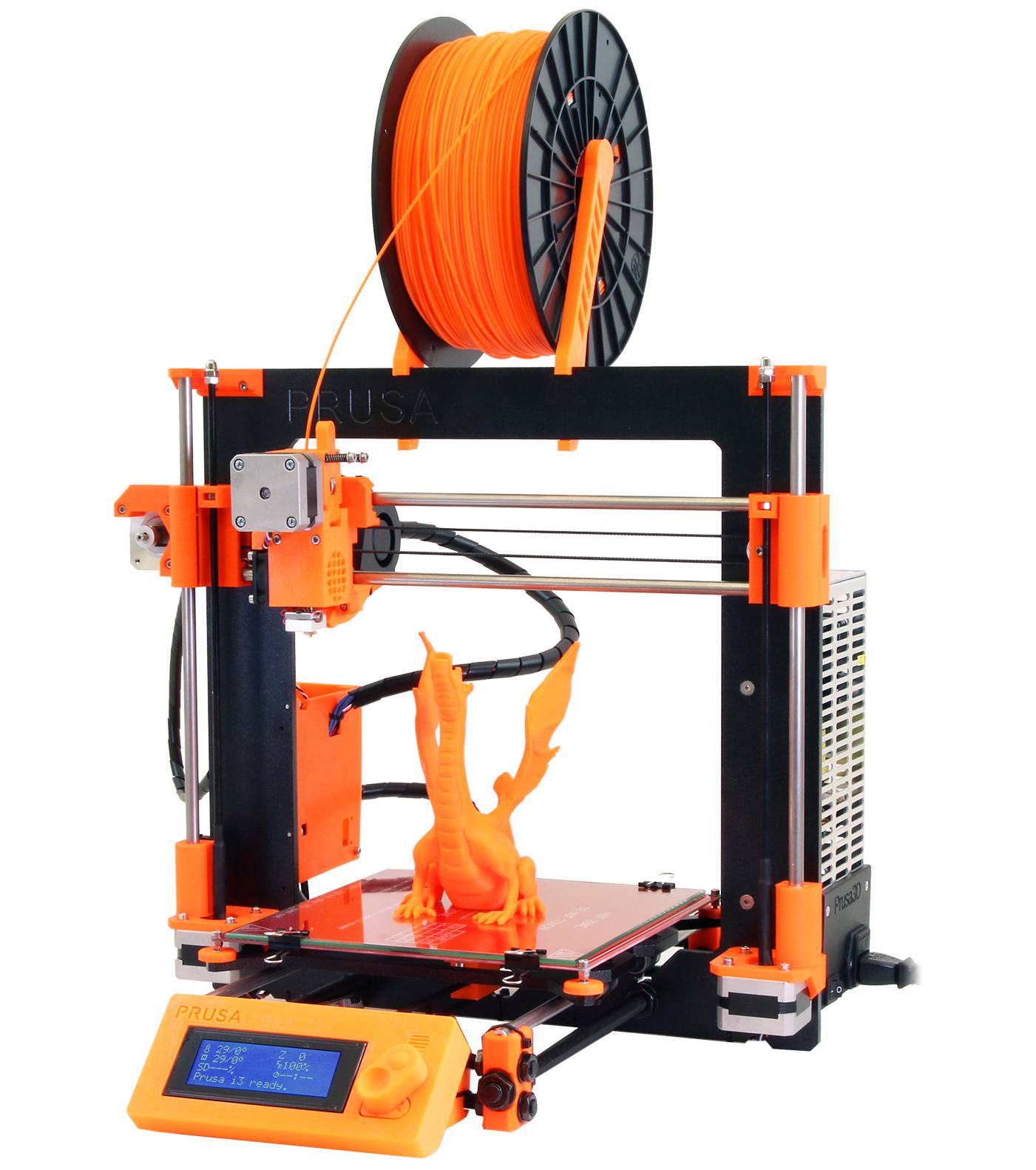
Image source:https://reprap.org/
1. Why NEMA17 Became the Default for Open-Source FDM Printers
NEMA 17 became the standard motor class for RepRap-derived printers for practical, not ideological, reasons. A typical Cartesian or CoreXY desktop printer does not need extreme shaft torque on the X and Y axes. What it needs is adequate dynamic torque at speed, manageable moving mass, acceptable motor heating, and compatibility with compact electronics. The reference NEMA 17 motors already cover a useful range for this role: about 13 Ncm for ultra-light applications, 42–45 Ncm for common motion axes, and around 60–65 Ncm for heavier beds, direct-drive extruders, or conservative motion tuning.
This aligns well with the mechanical logic of Prusa-style bed slingers and Voron-style CoreXY machines. In a Prusa i3 variant, the X-axis motor usually drives a light carriage through a timing belt, while the Y-axis often moves the print bed and therefore benefits from somewhat higher torque. In a Voron, the X/Y motors are fixed to the frame, so motor mass does not directly become moving mass, but higher rotor inertia still affects acceleration response and resonance behavior. In both cases, a moderate NEMA 17 is usually easier to tune than an oversized NEMA 23. That is why “enough torque with low penalty” is often the correct design target.
2. What NEMA23 Actually Changes
Moving from NEMA 17 to NEMA 23 is not a simple upgrade. It is a different design choice. The referenced NEMA 23 motors are physically larger, longer, and much higher in torque. Even the lighter examples are already around 1.16–1.26 Nm, and mainstream options sit near 1.9 Nm, while the largest listed example reaches 3.0 Nm. That is a substantial increase over the 45–65 Ncm range typical of strong NEMA 17 motors. Current demand also rises sharply, from around 2.0–2.1 A in common high-torque NEMA 17 examples to 2.8–3.5 A or more in typical NEMA 23 units.
The result is more available holding torque, but holding torque alone is not the governing number in a 3D printer. Desktop FDM printers spend much of their time in acceleration, deceleration, and frequent direction changes. In that regime, excess rotor inertia can be as important as static torque. A motor that looks stronger on paper may feel less responsive in a high-speed motion system if the rest of the drivetrain was designed around lighter motors and lower current drivers. This is one reason NEMA 23 is common in small CNC routers and heavy linear systems, but much less common in mainstream RepRap and Voron builds.
3. Printer Architecture Matters More Than Motor Size
A sensible motor selection scheme starts with the machine architecture.
In a classic RepRap or Prusa-style Cartesian printer, the X-axis usually has moderate load, the extruder load depends on direct-drive versus Bowden, and the Y-axis can be the heaviest moving axis because it carries the bed. For such machines, NEMA 17 is usually the rational baseline on all axes, with motor length and current selected by load. A light X-axis may run well on a shorter motor, while the Y-axis or direct-drive extruder may justify a 40–48 mm body and roughly 40–60 Ncm torque class.
In a Voron CoreXY printer, the X/Y motors are frame-mounted, but the system is designed around fast belt-driven kinematics, low moving gantry mass, and aggressive acceleration. Here, installing NEMA 23 motors is rarely the clean answer. The gains in static torque are offset by higher current requirement, larger package size, more heat, and often unnecessary torque reserve. In many Voron-class builds, the better path is a well-matched high-torque NEMA 17, a capable driver, adequate supply voltage, and careful tuning of current, input shaping, and belt path.
In Z-axis design, the calculation changes. If the printer uses lead screws and carries a heavy gantry or bed, the axis may need more low-speed torque and more holding margin. Even then, the common open-source solution is still usually NEMA 17, because lead screws already provide substantial mechanical advantage. NEMA 23 only becomes attractive when the Z assembly is unusually heavy, the screw geometry is demanding, or the machine crosses into large-format or hybrid printer-CNC territory.
4. Reading the Reference Motor Data Correctly
The provided supplier data shows why blanket rules are misleading. Not all NEMA 17 motors are “small,” and not all NEMA 23 motors are automatically excessive.
On the NEMA 17 side, the catalog includes a compact 42 × 42 × 20 mm motor rated at 13 Ncm and 1.0 A, a common 42 × 42 × 40 mm unit rated at 45 Ncm and 2.0 A, and a stronger 42 × 42 × 48 mm model rated at 65 Ncm and 2.1 A. That is already a broad usable range for desktop printers.
On the NEMA 23 side, a 57 × 57 × 56 mm motor is listed at 1.16 Nm and 1.5 A, another short-body model at 1.26 Nm and 2.8 A, a 57 × 57 × 76 mm model at 1.9 Nm and 2.8 A, and a 57 × 57 × 114 mm model at 3.0 Nm and 3.5 A. These numbers are impressive, but they also indicate the system-level cost: more copper, more current, more length, more mass, and more driver demand.
This leads to an important engineering conclusion: the motor should be selected from the load case backward, not from the frame size forward. If a printer axis only needs a fraction of the torque available from a properly sized NEMA 17, moving to NEMA 23 adds penalties without solving a real problem.
5. Dynamic Performance vs Static Torque
A common design mistake in DIY printer builds is overvaluing holding torque. Holding torque is measured at standstill. A 3D printer, however, is a dynamic system. The relevant question is not “How much torque can the motor resist when locked?” but “How much usable torque remains at the target speed and acceleration, with the actual driver, supply voltage, and motion profile?”
For belt-driven X/Y axes, especially in CoreXY machines, acceleration response and resonance control are critical. A very large motor may produce a stiffer low-speed feel, yet still degrade the overall motion envelope if its inertia reduces the system’s willingness to change speed rapidly. A smaller motor with adequate torque margin often produces a better print result because it can be driven more effectively in the actual operating band.
That is why NEMA 17 remains dominant in open-source 3D printing. It is not merely cheaper or more available. It is often the more balanced electromechanical match.
6. Selection Scheme for RepRap, Prusa, and Voron Builds
A practical scheme can be organized by axis and machine class.
For a small or medium RepRap printer, NEMA 17 should be treated as the default on every axis. Use lower-torque short-body motors only where mass and space are critical, such as a lightweight extruder or compact toolhead. Use mid-length 40 mm class motors around 40–45 Ncm for general X/Y duty. Move toward the 48 mm, 60–65 Ncm class when the bed is heavier, the carriage uses direct drive, or the machine is tuned conservatively for reliability. The supplier data supports exactly this spread.
For a Prusa-style bed slinger, the Y-axis deserves more attention than the X-axis because it carries the bed mass and printed part. In most cases, a higher-torque NEMA 17 on Y is a more intelligent step than redesigning around NEMA 23. The same logic applies to direct-drive extruders, where torque must overcome filament pressure and retraction transients, but packaging and thermal constraints remain tight.
For a Voron or other CoreXY machine, use NEMA 17 unless the design has moved far outside normal desktop territory. A good high-torque NEMA 17 with appropriate current and cooling is almost always preferable to a NEMA 23 retrofit. The machine geometry, mounts, electronics bay, and thermal design are generally optimized around NEMA 17-class components. Replacing them with NEMA 23 motors often forces cascading changes in mounts, drivers, power supply, and tuning strategy.
For a large-format printer, tall Z system, pellet extrusion platform, or a machine that is approaching light CNC duty, NEMA 23 becomes a serious candidate. In that case, it should be treated as part of a full system redesign rather than a drop-in upgrade. The reference catalog shows NEMA 23 becomes compelling once the machine genuinely needs torque in the 1.2–3.0 Nm class.
7. When NEMA23 Makes Sense
NEMA 23 is justified when the axis load is structurally heavy, the transmission ratio is unfavorable, or the machine is no longer a typical desktop FDM printer. Examples include very large moving beds, oversized gantries, long screw-driven Z stages, hybrid printer-router platforms, and industrial-style extruders with high melt pressure or large filament throughput. In those cases, the 1.16–3.0 Nm range offered by the referenced NEMA 23 models may be entirely appropriate.
It can also make sense when the designer deliberately prioritizes low-speed force over acceleration, such as in specialty deposition systems or slow, heavy process heads. But that is not the same use case as a mainstream Voron or Prusa build. For ordinary hobbyist or prosumer FDM printers, the extra motor class usually solves an imagined torque shortage rather than a measured one.
8. When NEMA17 Is the Better Engineering Choice
NEMA 17 is the better choice when the printer is belt-driven, speed-sensitive, space-constrained, or thermally limited. That covers the majority of RepRap, Prusa, and Voron machines. The available reference motors already demonstrate that NEMA 17 is not a single narrow category but a family that ranges from compact low-torque units to quite strong 60–65 Ncm motors.
For open-source printers, that flexibility matters. It allows the builder to tune motor length, current, and torque to the job without changing the entire mechanical standard of the machine. In design terms, this is more elegant than oversizing the motor frame and then compensating elsewhere.
9. Final Recommendation
For RepRap, Prusa, and Voron open-source 3D printers, NEMA 17 should be considered the default engineering choice, not merely the traditional one. It offers the right balance of torque, package size, current demand, and dynamic behavior for the vast majority of desktop FDM motion systems. The supplied motor data confirms that NEMA 17 already spans a practical range from 13 Ncm to 65 Ncm, which is sufficient for most X, Y, Z, and extruder duties in these platforms.
NEMA 23 should be selected only when the machine has moved beyond the operating assumptions of a normal desktop printer. The reference data shows why: it provides much more torque, but that torque comes with substantially higher current, larger size, and a heavier electromechanical footprint. In a large-format or quasi-industrial machine, that may be the correct trade. In a standard RepRap, Prusa, or Voron, it is usually not.
The most reliable selection rule is therefore simple: choose the smallest motor class that meets the dynamic torque requirement with reasonable thermal margin. For most open-source 3D printers, that answer remains NEMA 17. For unusually heavy or specialized builds, NEMA 23 becomes a design option—but only when the rest of the machine is engineered to support it.